Showing posts with label Framework. Show all posts

Friday, 14 February 2014

OWASP Xenotix XSS Exploit Framework v5


OWASP Xenotix XSS Exploit Framework is an advanced Cross Site Scripting (XSS) vulnerability detection and exploitation framework. It provides Zero False Positive scan results with its unique Triple Browser Engine (Trident, WebKit, and Gecko) embedded scanner. It is claimed to have the world’s 2nd largest XSS Payloads of about 1600+ distinctive XSS Payloads for effective XSS vulnerability detection and WAF Bypass. Xenotix Scripting Engine allows you to create custom test cases and addons over the Xenotix API. It is incorporated with a feature rich Information Gathering module for target Reconnaissance. The Exploit Framework includes offensive XSS exploitation modules for Penetration Testing and Proof of Concept creation.

Following are the V5 Additions

  • Xenotix Scripting Engine
  • Xenotix API
  • V4.5 Bug Fixes
  • GET Network IP (Information Gathering)
  • QR Code Generator for Xenotix xook
  • HTML5 WebCam Screenshot(Exploitation Module)
  • HTML5 Get Page Screenshot (Exploitation Module)
  • Find Feature in View Source.
  • Improved Payload Count to 1630
  • Name Changes

Xenotix Scripting Engine and API


This release features the Xenotix Scripting Engine that works on the top of Xenotix API. The Scripting Engine helps you to create tools and test cases on the go based on your requirements. There are situations when you have to go the manual way and since the ruleset set of an automated tool is not applicable in certain situations. Xenotix Scripting Engine powered by Xenotix API come into your rescue. Now you can make sure your tool works based on your requirements. Apply your Python scripting skills on the latest Scripting Engine.
Xenotix API features
  • 1630 XSS Detection Payloads.
  • An inbuilt GET Request XSS Fuzzer for Intelligent and Fast XSS Vulnerability Detection.
  • Analyze Response in Trident and Gecko Web Engines to make sure that there are no false positives.
  • Interact with Web Engines from the scope of a Python Script.
  • Make GET and POST Requests with one liner codes.

Reguirements

Tuesday, 7 January 2014

[Arachni v0.4.6 - Web User Interface v0.4.3] Open Source Web Application Security Scanner Framework


Arachni is a feature-full, modular, high-performance Ruby framework aimed towards helping penetration testers and administrators evaluate the security of web applications.

Arachni is smart, it trains itself by learning from the HTTP responses it receives during the audit process.

Unlike other scanners, Arachni takes into account the dynamic nature of web applications and can detect changes caused while travelling

through the paths of a web application’s cyclomatic complexity.

This way attack/input vectors that would otherwise be undetectable by non-humans are seamlessly handled by Arachni.


Changelog

Framework v0.4.6
  • Massively decreased RAM consumption.
  • Amount of performed requests cut down by 1/3 — and thus 1/3 decrease in scan times.
  • Overhauled timing attack and boolean/differential analysis algorithms to fix SQLi false-positives with misbehaving webapps/servers.
  • Vulnerability coverage optimizations with 100% scores on WAVSEP’s tests for:
    • SQL injection
    • Local File Inclusion
    • Remote File Inclusion
    • Non-DOM XSS — DOM XSS not supported until Arachni v0.5.
WebUI v0.4.3
  • Implemented Scan Scheduler with support for recurring scans.
  • Redesigned Issue table during the Scan progress screen, to group and filter issues by type and severity.

Tuesday, 31 December 2013

[Capstone] Ultimate Disassembly Framework

Capstone is a lightweight multi-platform, multi-architecture disassembly framework.

Our target is to make Capstone the ultimate disassembly engine for binary analysis and reversing in the security community.

Features

  • Support hardware architectures: ARM, ARM64 (aka ARMv8), Mips & X86 (more details).
  • Clean/simple/lightweight/intuitive architecture-neutral API.
  • Provide details on disassembled instruction (called “decomposer” by others).
  • Provide some semantics of the disassembled instruction, such as list of implicit registers read & written.
  • Implemented in pure C language, with bindings for Python, Ruby, OCaml, C#, Java and GO available.
  • Native support for Windows & *nix (including MacOSX, Linux, *BSD platforms).
  • Thread-safe by design.
  • Distributed under the open source BSD license.

Wednesday, 20 November 2013

[OMENS v1.17] The framework for distributing Actionable Intelligence

OMENS (Object Monitor for Enhanced Network Security) was born out of the intrusion (and intrusion attempts) analysis that I have been doing over many years. I consistently run into intrusion attempts that existing IDS systems have difficulty detecting. OMENS is my attempt to better detect (and understand) these blind spots in existing systems.

OMENS uses two primary methods to determine hostile activity. Scanning for hostile activity through signature comparisons, and base-lining to determine if any system changes have taken place.
OMENS is initially targeted at defending web servers, because the author of OMENS is most familiar with web based intrusions. However, the concepts employed by OMENS could be used in many other circumstances.

OMENS starts with scanning the web server log file for hostile activity. If it sees anything that matches the hostile signature database, it will report that activity in a report or via syslog.

OMENS also baselines the web server’s (web root) file system. If any changes are made in the files, those files are then scanned for hostile signatures, and any findings are again reported via report or syslog. One unique feature of OMENS is that it will also scan any modified or new files for obfuscated code. A common indicator of hostile files is that they contain obfuscated code. Obfuscation is commonly used to prevent detection. To my knowledge no existing scanner other than OMENS looks for this important indicator.
OMENS can also check the Windows Registry for hostile keys.

Download OMENS v1.17

Wednesday, 13 November 2013

OWASP Xenotix XSS Exploit Framework v4.5


Version 4.5 Additions
  • JavaScript Beautifier
  • Pause and Resume support for Scan
  • Jump to Payload
  • Cookie Support for POST Request
  • Cookie Support and Custom Headers for Header Scanner
  • Added TRACE method Support
  • Improved Interface
  • Better Proxy Support
  • WAF Fingerprinting
  • Load Files
  • Hash Calculator
  • Hash Detector

Saturday, 12 October 2013

[Sandy v0.1] Open-source Samsung phone encryption assessment framework


Sandy is an open-source Samsung phone encryption assessment framework. Sandy has different modules that allow you to carry out different attack scenarios against encrypted Samsung phones. For the details check our Derbycon 3.0 presentation (What’s common in Oracle and Samsung? They tried to think differently about crypto).

Requirements

  • It was developed with python 2.7.
  • Most of the modules works on OSX.
  • Every modules should work on Kali Linux.
  • You need pexpect, pbkdf2 and pyCrypto pyhton modules.

Friday, 20 September 2013

[Arachni v0.4.5.1-0.4.2] Open Source Web Application Security Scanner Framework


Arachni is a Free/Open Source project, the code is released under the Apache License Version 2.0 and you are free to use it as you see fit.

Initially started as an educational exercise, it has since evolved into a powerful and modular framework allowing for fast, accurate and flexible security/vulnerability assessments. More than that, Arachni is highly extend-able allowing for anyone to improve upon it by adding custom components and tailoring most aspects to meet most needs.


New Changes

  • Optimized pattern matching to use less resources by grouping patterns to only be matched against the per-platform payloads. Bottom line, pattern matching operations have been greatly reduced overall and vulnerabilities can be used to fingerprint the remote platform.
  • Modules
    • Path traversal ( path_traversal)
      • Updated to use more generic signatures.
      • Added dot-truncation for MS Windows payloads.
      • Moved non-traversal payloads to the file_inclusion module.
    • File inclusion ( file_inclusion) — Extracted from path_traversal.
      • Uses common server-side files and errors to identify issues.
    • SQL Injection ( sqli) — Added support for the following databases:
      • Firebird
      • SAP Max DB
      • Sybase
      • Frontbase
      • IngresDB
      • HSQLDB
      • MS Access
    • localstart_asp — Checks if localstart.asp is accessible.
  • Plugins — Added:
    • Uncommon headers ( uncommon_headers) — Logs uncommon headers.

Tuesday, 20 August 2013

[Xenotix XSS Exploit Framework v4] Advanced Cross Site Scripting (XSS) vulnerability detection and exploitation framework


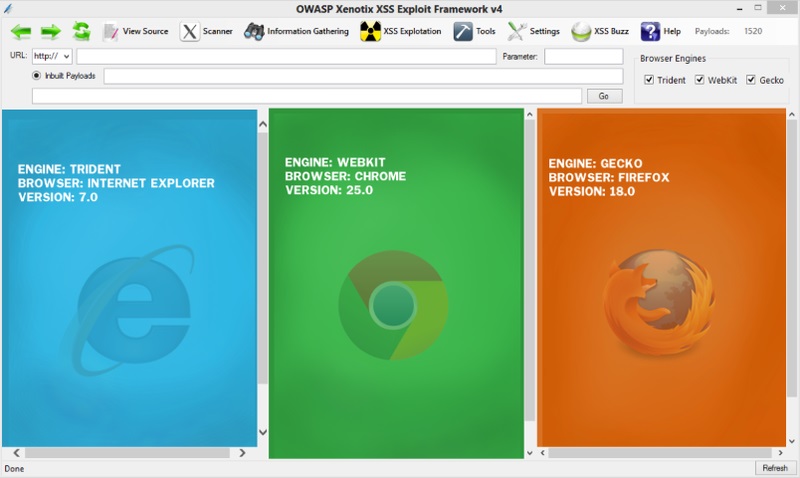
OWASP Xenotix XSS Exploit Framework is an advanced Cross Site Scripting (XSS) vulnerability detection and exploitation framework. It provides Zero False Positive scan results with its unique Triple Browser Engine (Trident, WebKit, and Gecko) embedded scanner. It is claimed to have the world’s 2nd largest XSS Payloads of about 1500+ distinctive XSS Payloads for effective XSS vulnerability detection and WAF Bypass. It is incorporated with a feature rich Information Gathering module for target Reconnaissance. The Exploit Framework includes highly offensive XSS exploitation modules for Penetration Testing and Proof of Concept creation.


SCANNER MODULES

  • Manual Mode Scanner
  • Auto Mode Scanner
  • DOM Scanner
  • Multiple Parameter Scanner
  • POST Request Scanner
  • Header Scanner
  • Fuzzer
  • Hidden Parameter Detector

INFORMATION GATHERING MODULES

  • Victim Fingerprinting
  • Browser Fingerprinting
  • Browser Features Detector
  • Ping Scan
  • Port Scan
  • Internal Network Scan

EXPLOITATION MODULES

  • Send Message
  • Cookie Thief
  • Phisher
  • Tabnabbing
  • Keylogger
  • HTML5 DDoSer
  • Executable Drive By
  • JavaScript Shell
  • Reverse HTTP WebShell
  • Drive-By Reverse Shell
  • Metasploit Browser Exploit
  • Firefox Reverse Shell Addon (Persistent)
  • Firefox Session Stealer Addon (Persistent)
  • Firefox Keylogger Addon (Persistent)
  • Firefox DDoSer Addon (Persistent)
  • Firefox Linux Credential File Stealer Addon (Persistent)
  • Firefox Download and Execute Addon (Persistent)

UTILITY MODULES

  • WebKit Developer Tools
  • Payload Encoder 

[Tunna Framework] Tool designed to bypass firewall restrictions on remote webservers


Tunna is a set of tools which will wrap and tunnel any TCP communication over HTTP. It can be used to bypass network restrictions in fully firewalled environments. The web application file must be uploaded on the remote server. It will be used to make a local connection with services running on the remote web server or any other server in the DMZ. The local application communicates with the webshell over the HTTP protocol. It also exposes a local port for the client application to connect to.

Since all external communication is done over HTTP it is possible to bypass the filtering rules and connect to any service behind the firewall using the webserver on the other end.

Tunna framework

Tunna framework comes witht he following functionality:

SECFORCE - penetration testing Ruby client - proxy bind: Ruby client proxy to perform the tunnel to the remote web application and tunnel TCP traffic.
SECFORCE - penetration testing Python client - proxy bind: Python client proxy to perform the tunnel to the remote web application and tunnel TCP traffic.
SECFORCE - penetration testing Metasploit integration module, which allows transparent execution of metasploit payloads on the server
SECFORCE - penetration testing ASP.NET remote script
SECFORCE - penetration testing Java remote script
SECFORCE - penetration testing PHP remote script


Tuesday, 13 August 2013

[Arachni v0.4.4] The Web Application Security Scanner Framework


Arachni is a Free/Open Source project, the code is released under the Apache License Version 2.0 and you are free to use it as you see fit.

Initially started as an educational exercise, it has since evolved into a powerful and modular framework allowing for fast, accurate and flexible security/vulnerability assessments. More than that, Arachni is highly extend-able allowing for anyone to improve upon it by adding custom components and tailoring most aspects to meet most needs.


Modules

There are new passive (recon) and active (audit) modules along with big coverage improvements for existing ones.

Recon

New

  • X-Forwarded-For Access Restriction Bypass ( x_forwarded_for_access_restriction_bypass)
    • Retries denied requests with a X-Forwarded-For header to try and trick the web application into thinking that the request originates from localhost and checks whether the restrictions were bypassed.
  • Form-based upload ( form_upload)
    • Flags file-upload forms as they require manual testing.

Improved

  • .htaccess LIMIT misconfiguration ( htaccess_limit)
    • Updated to use verb tampering as well.

Audit

New

  • Source code disclosure ( source_code_disclosure)
    • Checks whether or not the web application can be forced to reveal source code.
  • Code execution via the php://input wrapper ( code_execution_php_input_wrapper)
    • It injects PHP code into the HTTP request body and uses the php://input wrapper to try and load it.

Improved

  • Blind SQL Injection (Boolean/Differential analysis) ( sqli_blind_rdiff)
    • Improved accuracy of results.
  • Path traversal ( path_traversal)
    • Severity set to “High”.
    • Updated to start with / and go all the way up to /../../../../../../.
    • Added fingerprints for /proc/self/environ.
    • Improved coverage for MS Windows.
  • Remote file inclusion ( rfi)
    • Updated to handle cases where the web application appends its own extension to the injected string.


[Samurai Web Testing Framework v2.1] Live linux environment that has been pre-configured to function as a web pen-testing environment

The Samurai Web Testing Framework is a live linux environment that has been pre-configured to function as a web pen-testing environment. The CD contains the best of the open source and free tools that focus on testing and attacking websites. In developing this environment, we have based our tool selection on the tools we use in our security practice. We have included the tools used in all four steps of a web pen-test.


Starting with reconnaissance, we have included tools such as the Fierce domain scanner and Maltego. For mapping, we have included tools such WebScarab and ratproxy. We then chose tools for discovery. These would include w3af and burp. For exploitation, the final stage, we included BeEF, AJAXShell and much more. This CD also includes a pre-configured wiki, set up to be the central information store during your pen-test.

[Drozer] The Leading Security Testing Framework for Android.

drozer enables you to search for security vulnerabilities in apps and devices by assuming the role of an app and interacting with the Dalvik VM, other apps’ IPC endpoints and the underlying OS.
drozer provides tools to help you use and share public Android exploits. It helps you to deploy a drozer agent by using weasel – MWR’s advanced exploitation payload.
For the latest Mercury updates, follow @mwrdrozer.

Features

drozer allows you to use dynamic analysis during an Android security assessment. By assuming the role of an Android app you can:
  • find information about installed packages.
  • interact with the 4 IPC endpoints – activities, broadcast receivers, content providers and services.
  • use a proper shell to play with the underlying Linux OS (from the content of an unprivileged application).
  • check an app’s attack surface, and search for known vulnerabilities.
  • create new modules to share your latest findings on Android.
drozer’s remote exploitation features provide a unified framework for sharing Android payloads and exploits. It helps to reduce the time needed for vulnerability assessments and mobile red-teaming exercises, and includes the outcome of some of MWR’s cutting-edge research into advanced Android payloads and exploits.

How it Works

drozer does all of this over the network: it does not require ADB.

Tuesday, 6 August 2013

[Pytbull] IDS/IPS Testing Framework


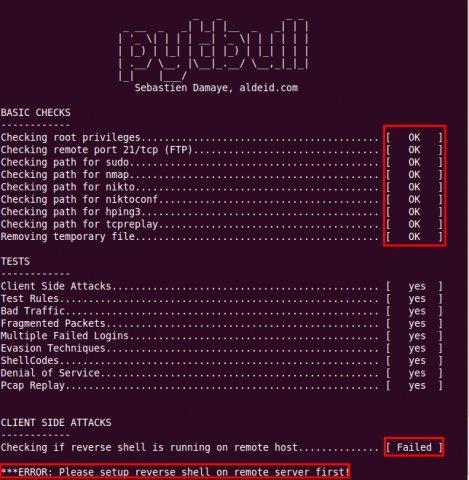
Pytbull is an Intrusion Detection/Prevention System (IDS/IPS) Testing Framework for Snort, Suricata and any IDS/IPS that generates an alert file. It can be used to test the detection and blocking capabilities of an IDS/IPS and to validate config.

[OWASP Xenotix XSS Exploit Framework v4 2013] Herramienta para detectar errores de Cross Site Scripting (XSS)


OWASP Xenotix XSS Exploit Framework es un herramienta para detectar errores de Cross Site Scripting (XSS). Xenotic ofrece un scanner triple para los motores de renderizado Trident de IE, WebKit de Chrome, Safari y Opera y Gecko de Mozilla Firefox y tiene más de 1.500 payloads distintivos para detectar eficientemente vulnerabilidades XSS y sobrepasar los WAF más utilizados.

Además, incorpora un módulo de recopilación de información para realizar reconocimiento del objetivo e incluye módulos de explotación ofensivos para realizar pruebas de penetración y pruebas de concepto sobre el mismo.

Módulos de escaneo

  • Manual Mode Scanner
  • Auto Mode Scanner
  • DOM Scanner
  • Multiple Parameter Scanner
  • POST Request Scanner
  • Header Scanner
  • Fuzzer
  • Hidden Parameter Detector 

Information Gathering

  • Victim Fingerprinting
  • Browser Fingerprinting
  • Browser Features Detector
  • Ping Scan
  • Port Scan
  • Internal Network Scan

Explotación

  • Send Message
  • Cookie Thief
  • Phisher
  • Tabnabbing
  • Keylogger
  • HTML5 DDoSer
  • Executable Drive By
  • JavaScript Shell
  • Reverse HTTP WebShell
  • Drive-By Reverse Shell
  • Metasploit Browser Exploit
  • Firefox Reverse Shell Addon (Persistent)
  • Firefox Session Stealer Addon (Persistent)
  • Firefox Keylogger Addon (Persistent)
  • Firefox DDoSer Addon (Persistent)
  • Firefox Linux Credential File Stealer Addon (Persistent)
  • Firefox Download and Execute Addon (Persistent)

Utilidades

  • WebKit Developer Tools
  • Payload Encoder 

Desde aquí se puede descargar el paper de su autor, ver los videos introductorios y la herramienta.


Tuesday, 23 July 2013

[HconSTF Pentest Browser] Open Source Penetration Testing / Ethical Hacking Framework


HconSTF is Open Source Penetration Testing Framework based on different browser technologies, Which helps any security professional to assists in the Penetration testing or vulnerability scanning assessments.contains webtools which are powerful in doing xss(cross site scripting), Sql injection, siXSS, CSRF, Trace XSS, RFI, LFI, etc. Even useful to anybody interested in information security domain - students, Security Professionals,web developers, manual vulnerability assessments and much more.

Wednesday, 10 July 2013

[Arachni v0.4.3] Ruby framework aimed towards helping penetration testers

Arachni is a feature-full, modular, high-performance Ruby framework aimed towards helping penetration testers and administrators evaluate the security of web applications.

Arachni is smart, it trains itself by learning from the HTTP responses it receives during the audit process.

Unlike other scanners, Arachni takes into account the dynamic nature of web applications and can detect changes caused while travelling through the paths of a web application’s cyclomatic complexity.

This way attack/input vectors that would otherwise be undetectable by non-humans are seamlessly handled by Arachni.


Changelog v0.4.3

Framework (v0.4.3)
  • Stable multi-Instance scans, taking advantage of SMP/Grid architectures for higher efficiency and performance.
  • Automated Grid load-balancing.
  • Platform fingerprinting for tailor-made audits resulting in less bandwidth consumption, less server stress and smaller scan runtimes.
Web User Interface (v0.4.1)
  • Support for PostgreSQL.
  • Support for importing data and configuration from the previous 0.4.2-0.4 packages.
Packages
  • Downgraded to require GLIBC >= 2.12 for improved portability.
More Information: here

Tuesday, 18 June 2013

[Dradis Pro v1.7] Framework to enable effective information sharing

Dradis Pro is framework to enable effective information sharing, specially during security assessments.
Dradis is a self-contained web application that provides a centralised repository of information to keep track of what has been done so far, and what is still ahead.


Changelog v1.7

This is the result of eight months of hard work, a bit longer than usual, but the release is packed with lots of handy improvements.
Here are some changes:
  • New Issue/Evidence architecture: read about why this is a big deal.
  • New all-in-one view (more below).
  • New “by host” and “by issue” reporting (more below).
  • New default project / report template: to make it easy for you to build on top of it.
  • New interface to import Issues from external sources.
  • New Qualys upload plugin.
  • Updated plugins
    • Burp upload
      • Generates Issue/Evidence
      • Is orders of magnitude faster.
      • Integrates with the Plugin Manager.
    • MediaWiki import is now compatible with versions 1.14 -> 1.21
    • Nessus upload generates Issue/Evidence
    • Nexpose upload generates Issue/Evidence
  • Updates and internal improvements:
    • Updated to Rails 3.2.13
    • Improved code block and table styling
Full Changelog: here

Merge the output from different tools into a single report.
  • Burp Suite
  • Nessus
  • NeXpose
  • Nikto
  • Nmap
  • OpenVAS
  • OSVDB
  • Qualys
  • Retina
  • SureCheck
  • VulnDB
  • w3af
  • MediaWiki
  • wXf
  • Zed Attack Proxy
Deliver consistent results.
  • Never forget any steps.
  • Follow your own testing methodology.
  • Create your own testing methodologies and improve them after every engagement.
  • Consistent results across projects and clients. Every time.
Everyone on the same page.
  • Work together towards a common goal.
  • All the information about the project in a single location where it’s easy to find.
More Information: here

Monday, 29 April 2013

[Mercury v2.2.0] The Android Assessment Framework

Mercury is a security assessment framework for the Android platform. It allows you to dynamically interact with the Inter-Process Communication (IPC) endpoints exported by an application installed on a device.
Mercury provides similar functionality to a number of static analysis tools, such as aapt, but offers far more flexibility by allowing you to interact with these endpoints from the context of an unprivileged application running on the same device.

The Android sandbox is designed to restrict the access of an unprivileged application to other applications and the underlying device, without requesting appropriate permissions. Once you’ve had a look with Mercury, you will be surprised at how much access you actually have.
Mercury was also a part of the latest Blackhat Arsenal 2013 Session in Amsterdam, where the awesome team has demoed neat features and few tricks pentesters can leverage to bypass restrictions and exploit vulnerabilities on Android Smartphones.

Mercury allows you to:
  1. Interact with the 4 IPC endpoints – activities, broadcast receivers, content providers and services
  2. Use a proper shell that allows you to play with the underlying Linux OS from the point of view of an unprivileged application (you will be amazed at how much you can still see)
  3. Find information on installed packages with optional search filters to allow for better control
  4. Built-in commands that can check application attack vectors on installed applications
  5. Tools to upload and download files between the Android device and computer without using ADB (this means it can be done over the internet as well!)
  6. Create new modules to exploit your latest finding on Android, and playing with those that others have found
Here is the latest changelog information as embedded with Mercury package

- Connections between Consoles and Agents can be encrypted with SSL.
- The Agent can require a password to be provided to establish a session.
- New Mercury modules can be downloaded and installed from the Internet, and
the local file system.
- Significant performance improvements to the Agent.

In addition, the following Github Issues have been closed:
Agent:

# 2 High CPU usage when polling for messages in Session.java.
# 1 High CPU usage on active connection in Server/Client.java.

Console:

# 50 Error when printing ContentProvider Path Permissions.
# 49 app.provider.delete does not work.
# 48 Python 2.x xrange/range optimization.
# 47 Some apps can crash scanner.provider.* modules.
# 44 Running app.package.manifest without specifying a package results in a
Null Pointer Exception.
# 43 Bug in app.provider.query.
# 34 Five, new 3rd Party ‘pilfer’ Modules.


The new console is compatible with the old agent, and vice-versa. However, this
configuration does not support SSL or password-on-connect.

Saturday, 20 April 2013

[SPF v0.1.7] Smartphone Pentest Framework - Support of the SMS shell pivot

The smartphone penetration testing framework, the result of a DARPA Cyber Fast Track project, aims to provide an open source toolkit that addresses the many facets of assessing the security posture of these devices. We will look at the functionality of the framework including information gathering, exploitation, social engineering, and post exploitation through both a traditional IP network and through the mobile modem, showing how this framework can be leveraged by security teams and penetration testers to gain an understanding of the security posture of the smartphones in an organization. We will also show how to use the framework through a command line console, a graphical user interface, and a smartphone based app.

SPF first release includes a text based management console, a web based GUI, and a management Android app.


  • SPF Console: The console is a text based Perl program that allows Smartphone Pentest Framework users to perform all the server functionality of SPF.
  • SPF Web based GUI: The GUI is a web based front end for SPF that allows users to perform all the server functionality. It is a set of Perl based webpages.
  • SPF Android App: The SPF Android App allows users to use the mobile modem of the Android smartphone with SPF to send SMS messages, gather information, etc. Users can also perform server functionality directly from Android smartphones using this application.
  • SPF Android Agent: The SPF Android Agent is one of Smartphone Pentest Framework’s post exploitation options. It is transparent to the user and allows SPF users to perform post exploitation tasks such as privilege escalation, information gathering, and remote control on Android phones with the agent installed. Agents for iPhone and Blackberry platforms are currently in development.

Changes for 0.1.7
    Added SMS shell pivot

Note: There is also a new script to install SPF on the newest KALI Pentest Plateform (https://github.com/georgiaw/Smartphone-Pentest-Framework/blob/master/kaliinstall). Don’t miss it.

Monday, 15 April 2013

[Canari Framework] Maltego Rapid Transform Development Framework


Canari is a rapid transform development framework for Maltego written in Python. The original focus of Canari was to provide a set of transforms that would aid in the execution of penetration tests, and vulnerability assessments. Ever since it's first prototype, it has become evident that the framework can be used for much more than that. Canari is perfect for anyone wishing to graphically represent their data in Maltego without the hassle of learning a whole bunch of unnecessary stuff. It has generated interest from digital forensics analysts to pen-testers, and even psychologists.

Canari's core features include:        - An easily extensible and configurable framework that promotes maximum reusability;      - A set of powerful and easy-to-use scripts for debugging, configuring, and installing transforms; -Finally, a great number of community provided transforms.